
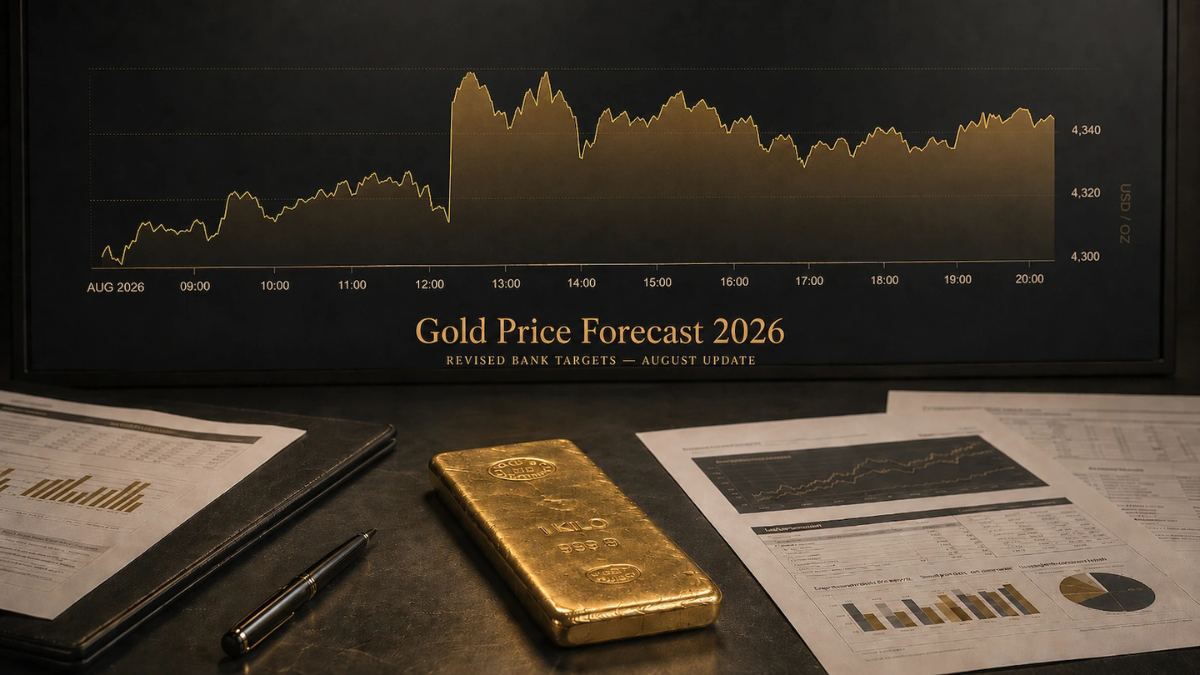
Gold prices have rebounded sharply in August 2026, with spot gold reaching about $4,649 per ounce on August 24 as a weaker U.S. dollar, lower bond yields and renewed demand pushed the metal to its highest level since May. The move has revived the question of whether gold can return to $5,000 before the end of 2026. Current forecasts remain wide because the outlook depends heavily on interest rates, the dollar, central-bank buying and geopolitical risk.
For example, an investor holding $10,000 worth of gold at $4,649 per ounce would own about 2.15 ounces before transaction costs. If gold reached $5,000, that holding would be worth roughly $10,754, producing a gain of about $754, or 7.5%. If gold instead fell to $4,000, the same holding would be worth about $8,604, creating a loss of roughly 14%. This illustrates why a forecast should be viewed as a range of possible outcomes rather than a guaranteed target.
What Is the Gold Price Forecast for 2026?
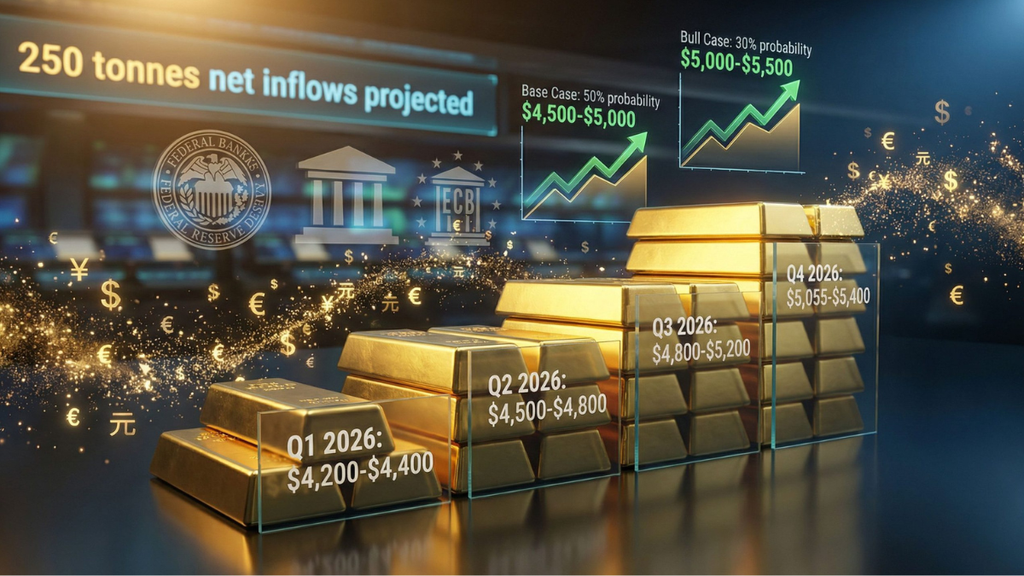
The current outlook is cautiously bullish but far from uniform. The London Bullion Market Association’s 2026 analyst survey shows an average gold forecast of $4,788 per ounce, with individual analyst forecasts ranging from $3,700 to $5,500. Standard Chartered’s Suki Cooper expects an average of $4,788, while Metals Focus forecasts an average of $4,850 and sees the possibility of prices reaching $5,500 during the year.
State Street Investment Management’s mid-year outlook provides a useful scenario framework. Its base case, assigned a 70% probability, places gold between $4,750 and $5,500 per ounce. Its bull case of $5,500 to $6,250 has a 15% probability, while its bear case of $4,000 to $4,750 also carries a 15% probability. The key point is that the expected range remains unusually broad.
That wide range reflects the unusual conditions surrounding gold in 2026. The metal reached an all-time high above $5,400 in January before falling below $4,000 in late June, according to the World Gold Council. By August, it had recovered above $4,600. Such a large swing shows that even a broadly bullish long-term trend can contain substantial corrections.
Why Gold Has Rebounded in August
The latest rally has been closely linked to movements in the U.S. dollar and Treasury yields. On August 24, Reuters reported that spot gold rose about 1% to $4,649.08 after reaching its highest level since May 15. Investors were watching upcoming U.S. inflation data and comments from Federal Reserve Chair Kevin Warsh, while expectations around interest rates continued to influence demand for the non-yielding metal.
A weaker dollar can support gold because the metal is priced internationally in U.S. dollars. When the dollar declines, gold can become relatively cheaper for buyers using other currencies. Lower bond yields can also improve gold’s relative appeal because investors receive less compensation for holding interest-bearing assets.
The relationship is not automatic. Gold can rise even when yields are high if investors are worried about inflation, geopolitical risks or currency stability. Likewise, a sharp rise in yields can pressure gold even when other fundamentals remain supportive.
The August move also followed an announcement by the U.S. Treasury to increase long-term bond buybacks. Reuters reported that the dollar weakened and gold jumped more than 4% on August 19 after the announcement, demonstrating how quickly changes in bond-market expectations can feed into precious-metal prices.
Central Banks Remain a Major Support for Gold
Central-bank demand has become one of the most important structural factors in the gold market. The World Gold Council reported that central banks bought 289 tonnes of gold on a net basis in the second quarter of 2026. That was 62% higher than the 177.9 tonnes recorded in the same quarter of 2025 and represented a record second quarter for central-bank buying.
The first half was less aggressive than the second quarter alone might suggest. Net central-bank demand reached 345 tonnes in the first half, the lowest first-half total since 2022. Even so, the World Gold Council said central banks intend to continue buying over the next 12 months, supporting the broader case for sustained demand.
This matters because central banks tend to purchase gold for strategic reasons rather than short-term trading. Reserve diversification, concerns about inflation and geopolitical uncertainty can encourage governments to increase gold holdings. That creates a different demand base from investors who may sell quickly when prices become volatile.
The composition of demand is also changing. The World Gold Council expects investment demand to remain the primary source of gold-demand growth during the rest of 2026, with Asian buying and over-the-counter activity becoming increasingly important. Jewellery demand, by contrast, is expected to remain under pressure because elevated prices make physical gold more expensive for consumers.
Interest Rates Could Decide the Next Major Move
Interest rates remain one of the most important variables for the gold price forecast 2026. Gold does not pay interest, so its opportunity cost tends to increase when inflation-adjusted bond yields rise. When real yields decline, the relative disadvantage of holding gold can become smaller.
The recent market action demonstrates this relationship. Gold rose strongly when Treasury yields fell and the dollar weakened, while it came under pressure on August 18 when global bond yields surged. Reuters reported that spot gold fell 1.1% that day to $4,364.90 as investors responded to higher yields and rising energy prices.
That creates two competing forces for the rest of the year. A more supportive monetary environment, particularly if inflation cools without causing a sharp increase in real yields, could help gold challenge previous highs. A more hawkish policy environment could produce another correction.
The inflation outlook is particularly important. Persistent inflation can support gold’s role as a store-of-value asset, but inflation that forces central banks to keep rates higher for longer can create a competing negative effect. The market therefore needs to distinguish between inflation that increases demand for hedges and inflation that pushes real yields higher.
Could Gold Reach $5,000 in 2026?
A return to $5,000 is plausible based on several institutional forecasts, but it should not be treated as a certainty. State Street’s base-case range already extends to $5,500, while its bull case reaches as high as $6,250. The LBMA survey also includes analysts with forecasts reaching $5,500.
Gold also traded above $5,400 earlier in the year, meaning $5,000 is not an unprecedented level for the 2026 market. The more difficult question is whether prices can remain above that threshold rather than simply touching it during a short-lived rally.
The January forecast from Goldman Sachs provides another example of how expectations can change quickly. Goldman raised its end-2026 target to $5,400 in January, citing private-sector and emerging-market central-bank diversification. It also identified a potential downside risk if perceptions of long-term monetary and policy risks improved significantly.
Forecasts made earlier in the year should therefore be treated carefully. Gold has already experienced a major correction and rebound since January, so the price target itself matters less than the assumptions behind it.
The Bear Case: Why Gold Could Fall Again
The biggest risk to the bullish gold outlook is a combination of stronger economic growth, higher real yields and a stronger U.S. dollar. If investors become more confident in risk assets and require less protection against inflation or geopolitical uncertainty, demand for gold could weaken.
State Street’s bear case places gold between $4,000 and $4,750. It identifies higher oil prices and the possibility of a Federal Reserve rate hike as factors that could test gold’s resilience around $4,000.
Gold’s own 2026 trading history provides a warning. After reaching an early-year record above $5,400, the metal fell below $4,000 by late June. That means investors should not assume that a move toward $5,000 would happen in a straight line.
High prices can also damage some parts of physical demand. The World Gold Council expects jewellery volumes to remain under pressure because consumers face elevated prices. Mine production and recycling may increase modestly as prices remain attractive, although the Council does not expect supply growth to be large enough to transform the market balance.
The Less Obvious Factor Behind the 2026 Outlook
One of the most important features of the current gold market is the changing balance between investment demand and traditional jewellery demand. The World Gold Council reported first-half 2026 gold demand of 2,522 tonnes, up 2% from a year earlier, while the value of that demand reached a record $380 billion.
That distinction matters. When prices rise sharply, jewellery buyers may purchase fewer ounces even while the total dollar value of purchases remains high. At the same time, investors and central banks can absorb supply at elevated prices because their motivations are different.
This creates a market where high prices can weaken one part of demand without necessarily destroying the overall bullish structure. In other words, gold does not need strong jewellery consumption to remain supported if investment and official-sector demand continue to expand.
The shift also means that future gold prices may respond more strongly to financial-market flows and policy expectations than to traditional physical jewellery demand. That is an important change for investors watching the market in 2026.
What Could Push Gold Above $5,000?
Several developments could increase the probability of a move above $5,000. A sustained decline in the U.S. dollar would provide one potential tailwind, particularly if it occurred alongside lower Treasury yields. A clear shift toward easier monetary policy could also reduce the opportunity cost of holding gold.
Geopolitical uncertainty is another major variable. The World Gold Council expects geopolitical factors to remain central to gold demand during 2026. It also expects central-bank buying to remain strong, while investment demand should continue to provide support.
Investor positioning will matter as well. Strong inflows into gold-backed exchange-traded products can accelerate a rally because financial investors can add exposure quickly. On the other hand, sudden outflows can amplify a correction, particularly when yields and the dollar are moving against gold.
The technical picture is also relevant, although it should not be confused with a fundamental forecast. Reuters reported on August 21 that gold had moved above its 200-day moving average near $4,513, while analysts were watching the $4,700 area as a potential next level.
What Readers Should Watch Next
The most important indicators for the remainder of 2026 are U.S. inflation, Treasury yields, Federal Reserve policy expectations and the U.S. dollar. These markets can change gold’s direction even when long-term demand remains strong.
Central-bank purchases should also remain on the radar. The second-quarter rebound to 289 tonnes shows that official-sector demand can return strongly after a temporary slowdown. If central banks continue buying at elevated levels, it would provide an important structural support for prices.
Investors should also watch whether gold can hold above the $4,500 area after its August rebound. A sustained move higher would strengthen the case for a retest of $5,000. A renewed break below major support, especially alongside rising real yields and a stronger dollar, would increase the probability of another correction.
For anyone considering gold as part of a portfolio, the main trade-off is clear. Gold can provide diversification and protection during periods of monetary, geopolitical and currency uncertainty, but it produces no regular income and can experience large drawdowns even within a long-term bullish cycle.
Conclusion
The gold price forecast 2026 remains constructive but highly uncertain. Gold is trading near $4,650 per ounce after a strong August rebound, while major forecasts span a wide range from bearish scenarios around $4,000 to bullish targets above $5,500. The LBMA analyst survey shows an average forecast of $4,788, while State Street’s base case places the metal between $4,750 and $5,500.
The path to $5,000 will depend largely on the interaction between U.S. interest rates, Treasury yields, the dollar, geopolitical risk and central-bank demand. Gold has already demonstrated in 2026 that large rallies can be followed by equally significant corrections, so the level of the forecast is less important than the conditions supporting it.
For the rest of the year, the clearest signals will come from real yields, Federal Reserve expectations, dollar direction and official-sector gold purchases. If those factors remain supportive, $5,000 is a credible scenario. If yields rise sharply and the dollar strengthens, gold could instead return toward the lower end of current forecast ranges.
One thought on “Gold Price Forecast 2026: Outlook and Key Targets”