
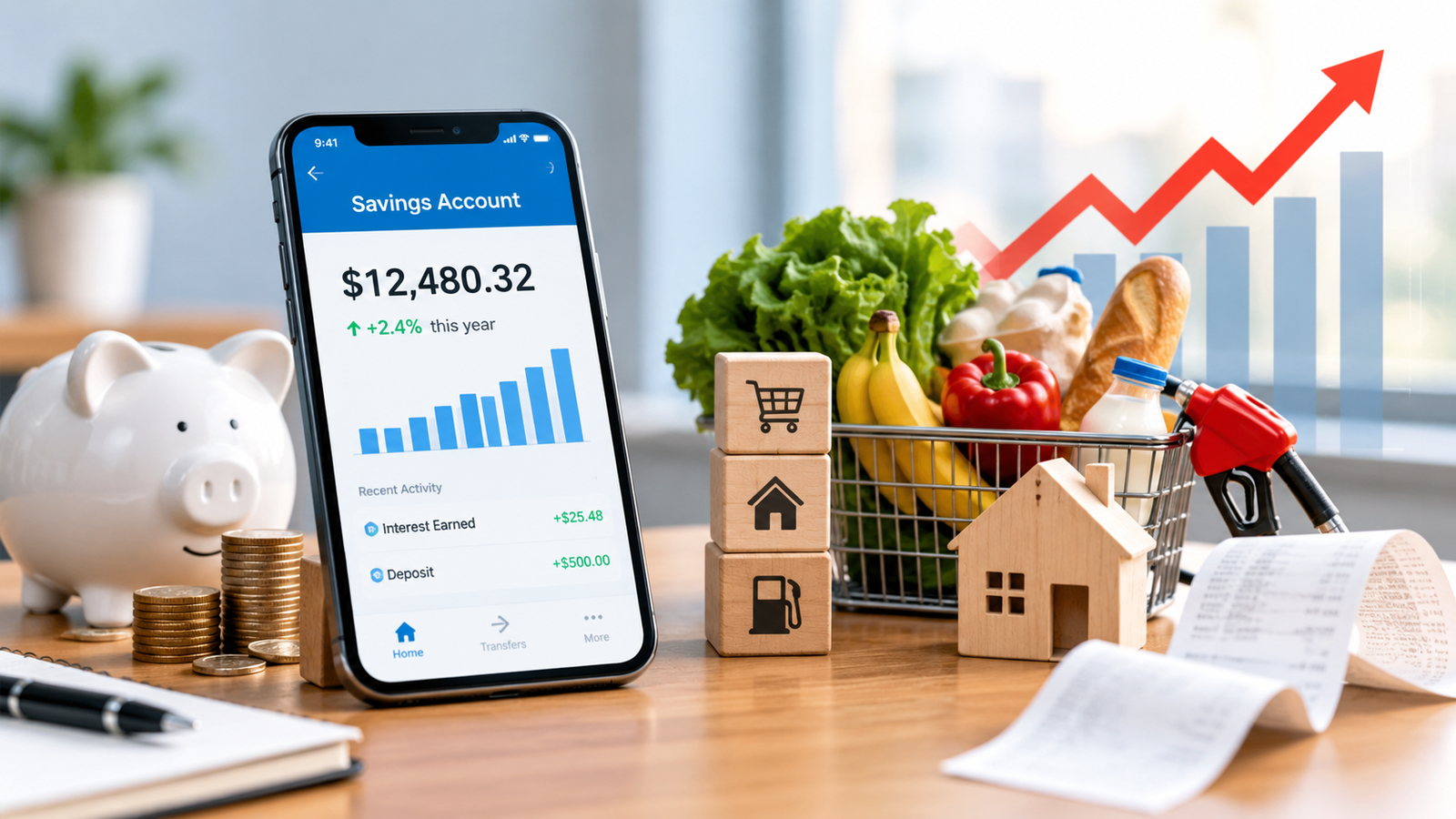
Keeping money in a savings account feels safe. Your balance is visible, your money is usually accessible, and unlike stocks, the account balance does not normally swing dramatically from one day to the next.
But there is another risk that is easy to overlook: inflation.
Even when the number in your savings account is increasing, the purchasing power of that money can be declining if the account’s interest rate is lower than inflation.
That is why the question is not simply, “Is my savings account earning interest?”
A better question is:
Is my savings account earning enough interest to keep up with rising prices?
The answer depends on the interest rate you receive, the inflation rate, taxes, fees and how long you keep the money in the account.
As of the latest available U.S. Consumer Price Index data, consumer prices increased 3.4% over the 12 months ending July 2026. The U.S. Bureau of Labor Statistics also reported that food prices increased 3.0% over the same period, while shelter prices rose 3.2%.
That makes the relationship between savings accounts and inflation particularly important for anyone holding significant amounts of cash.
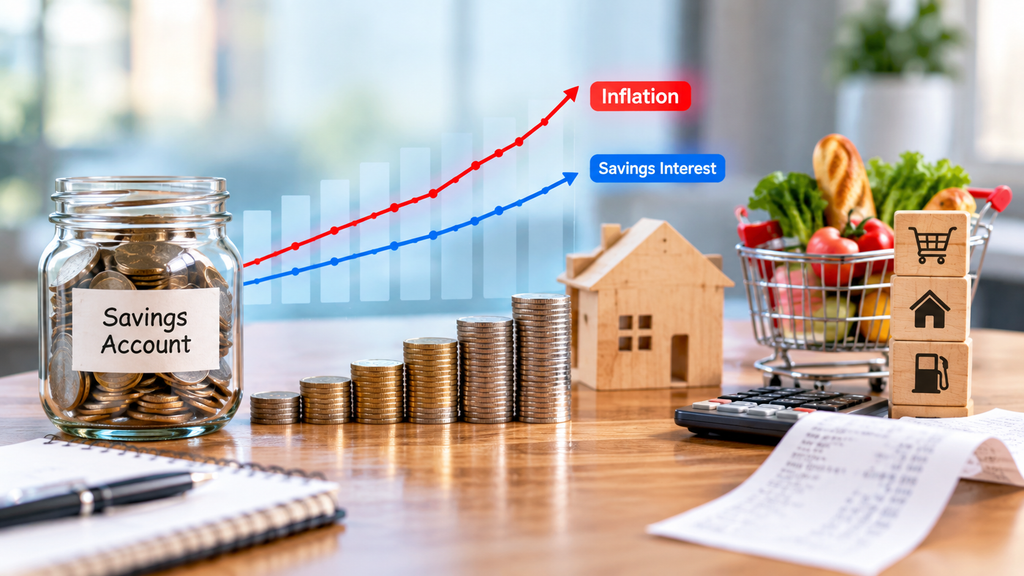
What Does Inflation Mean for Your Savings?
Inflation is the general increase in the prices of goods and services over time.
When prices rise, the purchasing power of money falls.
Investor.gov defines purchasing power as the amount of goods and services that a given unit of currency can buy after accounting for inflation.
Consider a simple example.
Suppose you have $10,000 in a savings account.
If prices rise by 3% over a year, the same $10,000 will generally buy less than it did a year earlier.
Your account may still show $10,000—or perhaps slightly more because of interest—but the amount of goods and services that money can purchase has changed.
This is why inflation can quietly reduce the real value of cash.
Savings Account vs Inflation: The Key Difference
The easiest way to understand the issue is to compare your savings account’s interest rate with inflation.
For example:
- Savings account interest rate: 2%
- Inflation rate: 3.4%
Your money is earning interest, but prices are increasing faster.
That means your nominal balance may rise while your real purchasing power declines.
A simplified real-return calculation is:
Real return ≈ Interest rate − Inflation rate
Using the example above:
2% − 3.4% = −1.4%
This is a simplified calculation rather than an exact after-tax real return, but it clearly demonstrates the problem.
Your money is growing in dollar terms while losing purchasing power in real terms.
What If Your Savings Account Pays More Than Inflation?
The situation changes when your savings account earns an interest rate above inflation.
Suppose:
- Savings interest rate: 4.5%
- Inflation: 3.4%
The simplified real return would be:
4.5% − 3.4% = 1.1%
In this scenario, your money is earning interest faster than prices are rising, before considering taxes and fees.
That does not mean the purchasing power of your money will increase by exactly 1.1%. The actual result depends on compounding, taxes, fees and the specific inflation measure relevant to your spending.
Still, the comparison provides a useful starting point.
Why a High Savings Rate Matters
Not all savings accounts pay the same interest rate.
Some traditional savings accounts may offer relatively low rates, while high-yield savings accounts can offer significantly higher rates depending on market conditions and the financial institution.
The difference can become meaningful over time.
Imagine two people each deposit $10,000.
Account A
Interest rate: 1%
After one year, ignoring compounding differences and taxes:
$10,000 × 1% = $100 interest
Balance: approximately $10,100
Account B
Interest rate: 4%
$10,000 × 4% = $400 interest
Balance: approximately $10,400
The difference is $300 in just one year.
Over larger balances and longer periods, the difference can become much more significant.
This is why comparing savings rates is an important part of managing cash.
But Inflation Is Not the Same for Everyone
One important point is often missed when people compare savings interest with inflation.
The official inflation rate represents an average change in prices across a broad basket of goods and services. Your personal inflation rate can be different.
For example, someone who spends a large percentage of their income on housing, transportation and food may experience different price changes from someone whose biggest expenses are healthcare, education or travel.
The July 2026 U.S. CPI data illustrates this variation. Overall consumer prices rose 3.4% over the year, while energy prices increased 14.7% and food prices increased 3.0%.
So even if your savings account appears to be keeping pace with headline inflation, your personal purchasing power could be changing differently.
How Much Does Inflation Reduce Purchasing Power?
Inflation becomes more powerful over long periods because it compounds.
Suppose inflation averages 3% annually.
A product costing $100 today would cost approximately:
- $103 after 1 year
- $134 after 10 years
- $181 after 20 years
- $243 after 30 years
These are mathematical illustrations, not forecasts of future inflation.
The important lesson is that even moderate inflation can have a substantial effect over decades.
The Federal Reserve has explained that low and stable inflation helps people make longer-term financial decisions because high inflation can rapidly reduce purchasing power.
Does Keeping Money in a Savings Account Mean You Are Losing Money?
Not necessarily.
A savings account serves an important purpose.
Cash is useful for:
- Emergency funds
- Short-term expenses
- Upcoming purchases
- Bills
- Near-term financial goals
- Money you cannot afford to expose to significant market volatility
The goal is not necessarily to eliminate cash.
The goal is to use cash for the right purpose.
If you need money in three months for a major expense, putting it into a volatile investment simply because inflation is high could create a different problem.
The value of a savings account is therefore not only its return.
It also provides liquidity and stability.
The Real Problem: Holding Too Much Cash for Too Long
The bigger issue can occur when someone keeps money in a low-interest account for many years without considering inflation.
For example, someone might accumulate $50,000 in cash because they want to feel financially secure.
Having an emergency reserve is sensible.
But if only $10,000 is needed for emergencies and the remaining $40,000 is intended for a long-term goal 15 or 20 years away, keeping every dollar in a low-interest savings account could expose the long-term money to substantial purchasing-power erosion.
The appropriate strategy depends on the purpose and time horizon of the money.
Savings Accounts and Short-Term Goals
Savings accounts can be particularly appropriate for short-term financial goals.
Examples include:
- A vacation next year
- A car purchase
- A home down payment in the near future
- Emergency expenses
- Insurance premiums
- Tuition or other upcoming bills
For these goals, protecting the principal and maintaining access to the money may be more important than maximizing investment returns.
You generally do not want to take significant stock-market risk with money you know you will need soon.
What About Long-Term Savings?
Long-term money is different.
If you are saving for a goal that is 10, 20 or 30 years away, inflation becomes a much larger consideration.
Keeping all long-term savings in cash may protect you from market volatility, but it does not necessarily protect purchasing power.
Long-term investors may therefore consider a diversified investment strategy appropriate to their goals and risk tolerance.
Possible assets can include:
- Stocks
- Bonds
- Treasury securities
- Inflation-linked securities
- Diversified funds
- Other investments appropriate to the investor’s circumstances
Each has different risks.
There is no single investment that is guaranteed to beat inflation every year.
How to Protect Savings From Inflation
There are several practical steps you can take.
1. Compare Savings Account Rates
Do not automatically assume your current bank offers the best available rate.
Compare the interest rate, minimum balance requirements, fees, withdrawal rules and other terms.
A higher rate can make a meaningful difference, especially on large cash balances.
2. Keep an Emergency Fund
Do not invest every dollar simply because inflation is reducing purchasing power.
An emergency fund can help prevent unexpected expenses from forcing you to sell investments or borrow at high interest rates.
The appropriate amount depends on your income, expenses, job stability and personal circumstances.
3. Separate Short-Term and Long-Term Money
Instead of treating all your savings as one pool, divide it according to purpose.
For example:
Short-term money: cash or savings account
Medium-term money: potentially a combination of conservative assets depending on the goal
Long-term money: a diversified investment strategy appropriate to your risk tolerance
The exact allocation should depend on your situation.
4. Review Your Interest Rate Regularly
Savings rates can change.
An account that was competitive when you opened it may become less competitive later.
Review the rate periodically rather than assuming it will remain attractive forever.
5. Consider Taxes
Interest income may be taxable depending on your country, account type and personal circumstances.
A savings account paying 4% does not necessarily mean you keep the entire 4%.
That means the relevant comparison may be between your after-tax interest rate and inflation.
Savings vs. Investing: Which Is Better Against Inflation?
The answer depends on your goal.
Savings accounts generally prioritize:
- Liquidity
- Stability
- Capital preservation
- Short-term accessibility
Investments generally provide:
- Greater long-term growth potential
- Greater market risk
- More price volatility
- Better potential for long-term purchasing-power growth
Neither is universally better.
A savings account may be ideal for an emergency fund but less suitable for money that will not be needed for decades.
Likewise, investing may be appropriate for long-term wealth building but unsuitable for money required next month.
The key is matching the financial tool to the time horizon.
What Happens When Inflation Falls?
Inflation does not always remain high.
If inflation declines while your savings rate stays relatively strong, the real return on cash can improve.
The Federal Reserve’s long-run inflation objective is 2%, and its July 2026 Monetary Policy Report noted that inflation remained above that goal at that time.
This is one reason investors should avoid making permanent financial decisions based only on one month’s or one year’s inflation rate.
Interest rates and inflation can change.
Your strategy should be reviewed as economic conditions change.
A Simple Way to Check Whether Inflation Is Eating Your Savings
You can perform a quick annual review.
Step 1: Find your savings account’s annual interest rate.
For example:
3.0%
Step 2: Find the latest inflation rate.
For example:
3.4%
Step 3: Compare them.
3.0% − 3.4% = −0.4%
Your approximate nominal return is below the headline inflation rate.
Step 4: Consider taxes and fees.
If your interest is taxable or the account has fees, your actual real return may be lower.
This simple exercise can show whether your cash is at least keeping pace with the general rise in prices.
Don’t Chase High Returns With Your Emergency Fund
There is another danger in trying too hard to beat inflation.
You might move emergency savings into investments with substantially higher risk.
That can backfire.
Imagine your emergency fund is invested in stocks and the market falls just when you lose your job.
You may then have to sell investments at depressed prices to cover essential expenses.
The potential return was higher, but the investment did not serve the purpose of an emergency fund.
This is why financial goals should come before investment returns.
The Bottom Line
A savings account can protect your money from many risks, but it does not automatically protect your purchasing power from inflation.
If your savings account earns less than the inflation rate, your balance may grow while its real purchasing power declines.
The latest U.S. CPI data available as of September 6, 2026 showed annual inflation of 3.4% through July 2026, while the Federal Reserve continued to describe inflation as elevated relative to its 2% longer-run goal.
That does not mean you should abandon savings accounts.
Instead, think of your money in terms of purpose, time horizon and purchasing power.
Keep enough liquid cash for emergencies and short-term needs. Compare savings rates so your cash is working as efficiently as possible. For long-term goals, consider whether a diversified investment strategy is more appropriate for your risk tolerance and time horizon.
The key lesson is simple:
A savings account protects the number of dollars you have. The right long-term strategy also needs to consider what those dollars will be able to buy.
2 thoughts on “Savings Account vs Inflation: Is Your Money Losing Value?”