
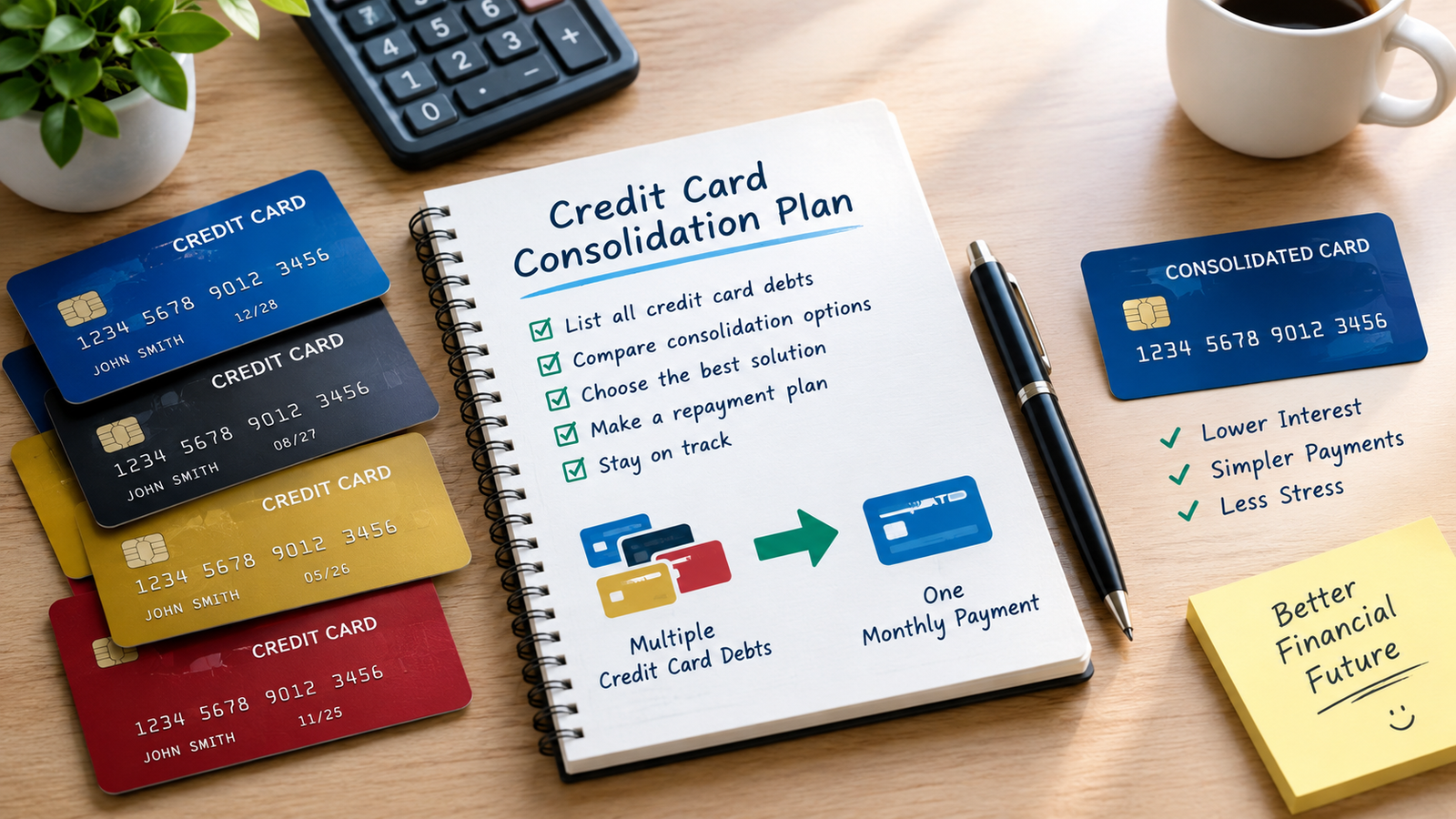
Managing multiple credit card balances can make debt feel complicated and expensive. Different interest rates, payment dates, minimum payments, and balances can make it difficult to know where your money is going.
Credit card consolidation can simplify this situation by combining multiple credit card debts into a single payment or using one financial strategy to make the debt easier to manage.
However, consolidation is not automatically the best choice for everyone. Depending on the interest rate, fees, repayment period, and your spending habits, it can either help you become debt-free more efficiently or increase the total cost of your debt.
This guide explains how credit card consolidation works, the main options available, its benefits and risks, and what to consider before choosing a strategy.
What Is Credit Card Consolidation?
Credit card consolidation is the process of combining multiple credit card debts into one debt or using one repayment method to manage several balances.
For example, imagine you have:
- Credit Card A: $2,500 balance
- Credit Card B: $1,800 balance
- Credit Card C: $1,200 balance
Your total credit card debt is $5,500.
Instead of managing three separate balances and payments, you might consolidate the debt into one account with a potentially lower interest rate or a simpler repayment structure.
The goal is usually to make debt repayment easier, reduce interest costs where possible, or both.
How Does Credit Card Consolidation Work?
The exact process depends on the consolidation method you choose.
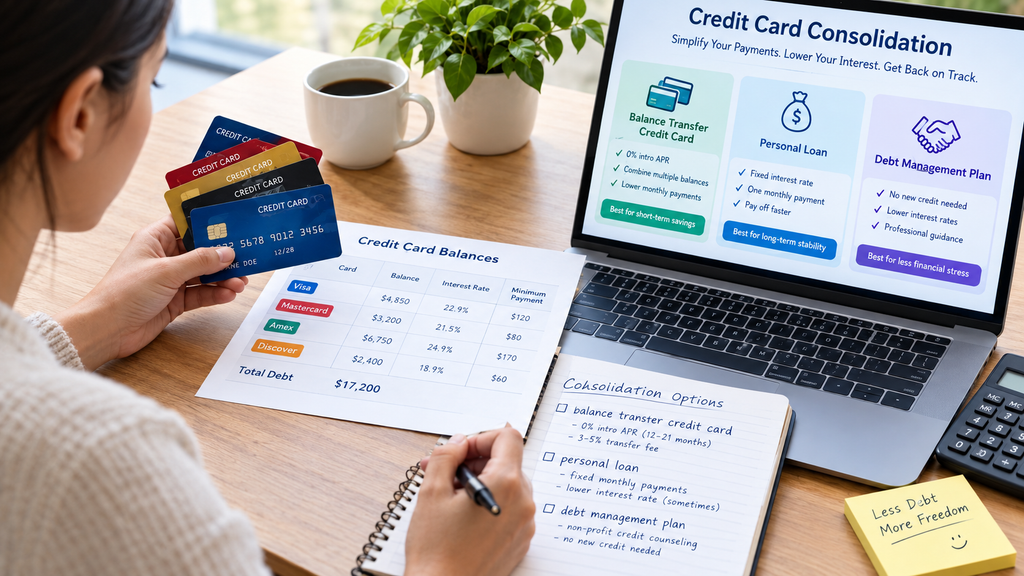
One common approach is using a personal loan to pay off multiple credit cards. After the cards are paid off, you make payments on the new loan instead.
Another option is a balance transfer credit card, which may allow you to move balances from existing cards to a new card with a promotional interest rate.
Other approaches include debt management plans and, in certain circumstances, home-equity-based borrowing.
The important point is that consolidation does not eliminate your debt. It changes how the debt is structured or repaid.
Common Credit Card Consolidation Options
There are several ways to consolidate credit card debt.
1. Personal Loan
A personal loan can be used to pay off multiple credit card balances.
You then make one monthly payment on the personal loan rather than separate payments on several credit cards.
A personal loan may be useful when its interest rate and fees are lower than the rates on your existing credit cards.
However, compare the total cost of the loan, not just the monthly payment.
2. Balance Transfer Credit Card
A balance transfer allows you to move debt from one or more credit cards to another credit card.
Some balance transfer cards offer a promotional period with a low or 0% introductory APR.
This can provide an opportunity to pay down principal without accumulating the same level of interest during the promotional period.
However, balance transfers commonly involve fees, and the promotional rate eventually ends.
You also need to make required payments on time and understand what happens to the remaining balance after the promotional period.
3. Debt Management Plan
A debt management plan can help some people organize unsecured debt repayment through a structured plan.
A credit counseling organization may work with creditors and help establish a repayment schedule.
Depending on the arrangement, you may make one payment to the counseling organization, which then distributes payments to creditors.
Before using this option, research the organization carefully and understand all fees and terms.
4. Home Equity Loan or HELOC
Homeowners may consider using home equity to pay off credit card debt.
Because these products are secured by your home, their interest rates can sometimes be lower than unsecured credit card rates.
But this approach carries significant risk.
If you use your home as collateral and cannot meet the repayment obligations, you could put your home at risk.
For that reason, home-equity borrowing should be considered carefully rather than treated as an easy credit card solution.
5. Paying Off Cards With Your Existing Income
Consolidation does not always require a new loan or credit account.
You can also simplify repayment by focusing your available income on existing balances.
For example, you might continue making the minimum payments on all cards while directing extra money toward one balance at a time.
Once one balance is eliminated, you can redirect that payment toward the next debt.
This approach does not consolidate the accounts technically, but it can simplify your repayment strategy without taking on new borrowing.
Benefits of Credit Card Consolidation
Credit card consolidation can offer several potential advantages.
Simplified Payments
Managing one payment instead of several can make your debt easier to track.
You may have fewer payment dates to remember and a clearer view of your repayment progress.
Potentially Lower Interest Costs
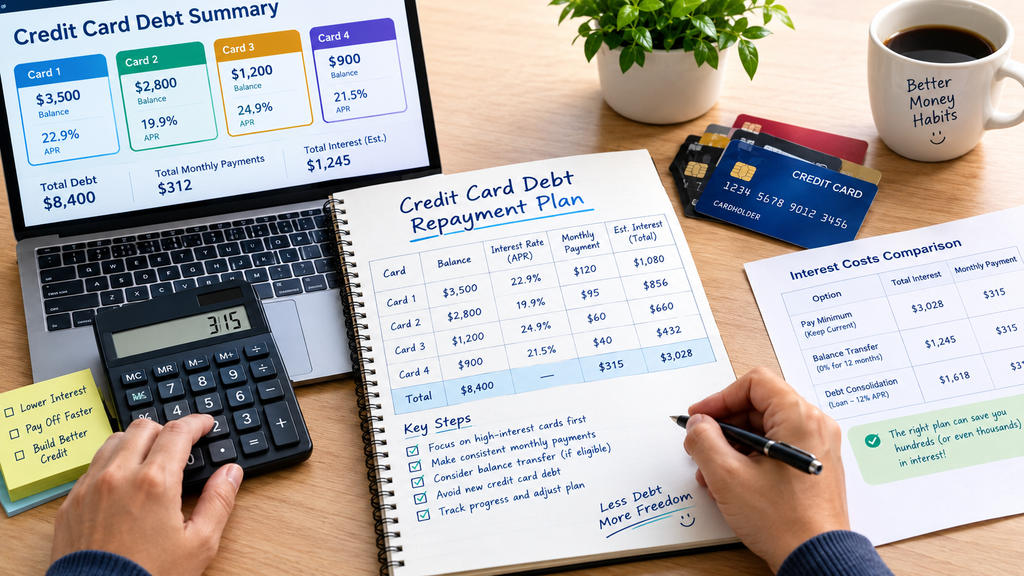
If you qualify for a consolidation option with a lower interest rate than your current credit cards, more of your payment may go toward reducing the principal.
For example, replacing high-interest credit card debt with a lower-rate loan could reduce interest costs.
However, this depends on the actual rates, fees, and repayment period.
Easier Debt Management
Multiple credit cards can make it difficult to understand your total debt.
Consolidating balances can give you a clearer repayment structure.
A Fixed Repayment Schedule
Some personal loans have fixed monthly payments and a defined repayment term.
Knowing when the debt is scheduled to be paid off can make long-term planning easier.
Risks of Credit Card Consolidation
Consolidation also has potential disadvantages.
You May Pay More Overall
A lower monthly payment does not necessarily mean a cheaper loan.
If consolidation extends your repayment period significantly, you could pay more interest over the life of the debt.
Always compare total repayment costs.
Fees Can Reduce the Savings
Depending on the option, you may encounter:
- Origination fees
- Balance transfer fees
- Annual fees
- Closing costs
- Counseling or program fees
Calculate these costs before deciding.
Your Credit Score May Be Affected
Applying for new credit can result in a hard credit inquiry, and opening or closing accounts can affect your credit profile.
The effect varies depending on your overall credit history and how the accounts are managed.
Consolidation Doesn’t Fix Overspending
This is one of the most important considerations.
If you consolidate your credit cards but continue spending beyond your budget, you could end up with new credit card balances while still paying the consolidation loan.
Consolidation works best when it is combined with changes to the habits that created the debt.
When Does Credit Card Consolidation Make Sense?
Consolidation may be worth considering when:
- You have several high-interest credit card balances.
- You can qualify for a lower-cost repayment option.
- You want to simplify multiple monthly payments.
- You have stable income to support the new payment.
- You have a clear plan to avoid accumulating new credit card debt.
- The total cost is lower or the repayment structure provides a meaningful benefit.
The numbers matter more than the name of the product.
A consolidation option should improve your financial situation rather than simply move the debt somewhere else.
When Might Consolidation Not Be a Good Idea?
Consolidation may not be appropriate if:
- The new interest rate is not meaningfully lower.
- Fees eliminate the potential savings.
- You are likely to continue using the paid-off credit cards.
- The new repayment period is much longer.
- Your income is too unstable to support the new payment.
- You would need to put an important asset at unnecessary risk.
If your debt problem is primarily caused by spending more than your income, changing your budget may be more important than finding another credit product.
Credit Card Consolidation Example
Suppose you have three credit cards:
| Credit Card | Balance | APR |
| Card A | $3,000 | 24% |
| Card B | $2,000 | 22% |
| Card C | $1,000 | 26% |
| Total | $6,000 | — |
You may investigate a consolidation loan with a lower interest rate.
If you qualify for a loan at a significantly lower APR and the fees are reasonable, consolidation could potentially reduce interest costs and replace three payments with one.
But you should compare:
Current debt cost
vs.
New loan principal + interest + fees
This comparison is more important than simply comparing monthly payments.
How to Compare Consolidation Options
Before accepting an offer, compare the following factors:
Interest Rate
Look at the APR rather than focusing only on the advertised monthly payment.
Fees
Find out whether there are upfront or ongoing fees.
Repayment Period
A longer term can reduce the monthly payment but may increase total interest.
Monthly Payment
Make sure the payment fits comfortably within your budget.
Total Repayment
Calculate how much you will pay from beginning to end.
Promotional Terms
For balance transfers, understand exactly when the promotional rate ends and what rate may apply afterward.
Credit Card Consolidation vs. Debt Settlement
These strategies are different.
Debt consolidation generally involves restructuring or combining debt while continuing to repay what you owe.
Debt settlement typically involves attempting to negotiate with creditors to accept less than the full amount owed.
Debt settlement can carry significant financial and credit consequences, and it is not the same as consolidation.
Understanding the difference is important before choosing a debt-relief strategy.
How to Avoid Getting Back Into Credit Card Debt
Consolidation can make repayment easier, but maintaining progress requires good financial habits.
Create a Personal Budget
Know how much money comes in and where it goes each month.
Build an Emergency Fund
Even a small emergency fund can reduce the need to rely on credit cards when unexpected expenses occur.
Stop Unnecessary Credit Card Spending
If you consolidate your balances but continue using the cards for unnecessary purchases, your total debt may rise again.
Track Your Progress
Review your remaining balance regularly.
Watching the balance decline can help you stay focused on the goal.
Increase Payments When Possible
If your income increases or you reduce expenses, consider putting some of the extra money toward debt repayment.
Questions to Ask Before Consolidating Credit Card Debt
Before choosing a consolidation option, ask yourself:
- What is my total credit card debt?
- What interest rates am I currently paying?
- What APR would I receive through consolidation?
- What fees would I pay?
- How long would repayment take?
- What would be my total repayment cost?
- Can I comfortably afford the new payment?
- Will I stop adding new credit card debt?
- Could the strategy put important assets at risk?
- Is there a simpler option that costs less?
Writing down the answers can make your decision much clearer.
Final Thoughts
Credit card consolidation can be a useful debt-management strategy when it reduces costs, simplifies payments, or provides a realistic path toward becoming debt-free.
But consolidation itself is not a solution to overspending. Before choosing an option, compare interest rates, fees, repayment periods, monthly payments, and total costs.
If you decide to consolidate, combine the strategy with a realistic personal budget, responsible credit use, and a plan for handling unexpected expenses.
The goal is not simply to move credit card debt into another account. The goal is to create a repayment plan that helps you regain control of your finances and steadily reduce what you owe.
One thought on “Credit Card Consolidation: How It Works, Benefits, Risks, and Options”