
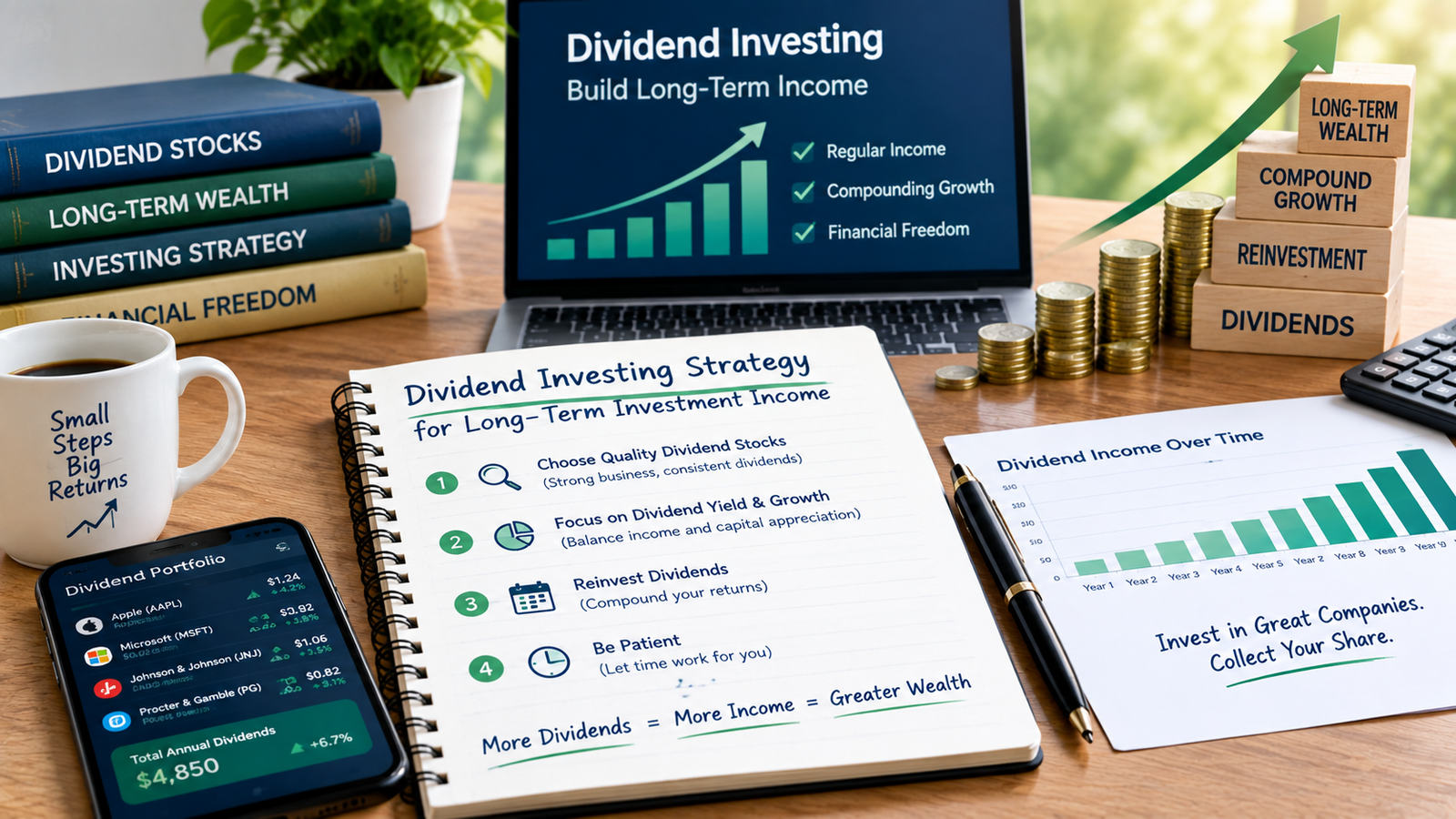
Investing in stocks can offer more than the potential for share-price growth. Some companies also distribute part of their profits to shareholders through dividends.
This is where dividend investing comes in.
Dividend investing focuses on owning shares of companies that regularly pay dividends. Investors may use these payments as income, reinvest them to purchase additional shares, or combine dividend income with long-term capital appreciation.
However, dividend investing is not simply about finding stocks with the highest dividend yield. A high dividend can sometimes signal greater risk, and companies can reduce or suspend their dividends.
This guide explains how dividend investing works, what to look for in dividend stocks, the potential benefits and risks, and how beginners can approach this strategy.

What Is Dividend Investing?
Dividend investing is an investment strategy that involves buying shares of companies that distribute a portion of their earnings to shareholders.
For example, suppose you own 100 shares of a company that pays an annual dividend of $2 per share.
Your annual dividend income would be:
100 × $2 = $200
If the company continues paying the dividend, you may receive additional income while still owning the shares.
Some investors choose to receive dividends as cash. Others reinvest them by purchasing more shares.
How Do Dividends Work?
When a company earns profits, it can use that money in several ways.
It may:
- Reinvest in the business
- Pay down debt
- Acquire another company
- Buy back shares
- Hold cash
- Distribute part of the profits to shareholders
When a company declares a dividend, it announces how much shareholders will receive per eligible share.
For example:
Dividend: $0.50 per share
Shares owned: 200
Potential dividend payment:
200 × $0.50 = $100
Dividend payments are not guaranteed. A company’s board can change, reduce, or eliminate a dividend depending on its financial condition and strategy.
Why Do Companies Pay Dividends?
Mature and profitable companies may pay dividends because they generate more cash than they currently need to reinvest in the business.
Dividends can also make shares attractive to investors who want regular income.
However, not every successful company pays dividends.
Some companies prefer to reinvest their profits into growth opportunities rather than distribute cash to shareholders.
What Is Dividend Yield?
Dividend yield measures the annual dividend relative to a stock’s current price.
A simplified formula is:
Dividend Yield = Annual Dividend per Share ÷ Stock Price × 100
For example, if a stock pays $3 in annual dividends and trades at $60:
$3 ÷ $60 × 100 = 5%
The dividend yield would be 5%.
Dividend yield is useful, but it should not be the only factor you consider.
A very high yield may sometimes occur because the stock price has fallen sharply. If the company’s financial situation is deteriorating, the dividend may not be sustainable.
Dividend Yield vs. Dividend Growth
Dividend investors often consider two different characteristics.
High Dividend Yield
A high-yield stock may provide more income relative to the amount invested.
For example, a 6% yield produces more current income than a 2% yield, assuming the dividends are maintained.
Dividend Growth
A company with a lower current yield may increase its dividend over time.
For example, a company might currently yield 2.5% but consistently increase its dividend as earnings and cash flow grow.
For long-term investors, dividend growth can be important because increasing dividends may improve future income.
What Is Dividend Reinvestment?
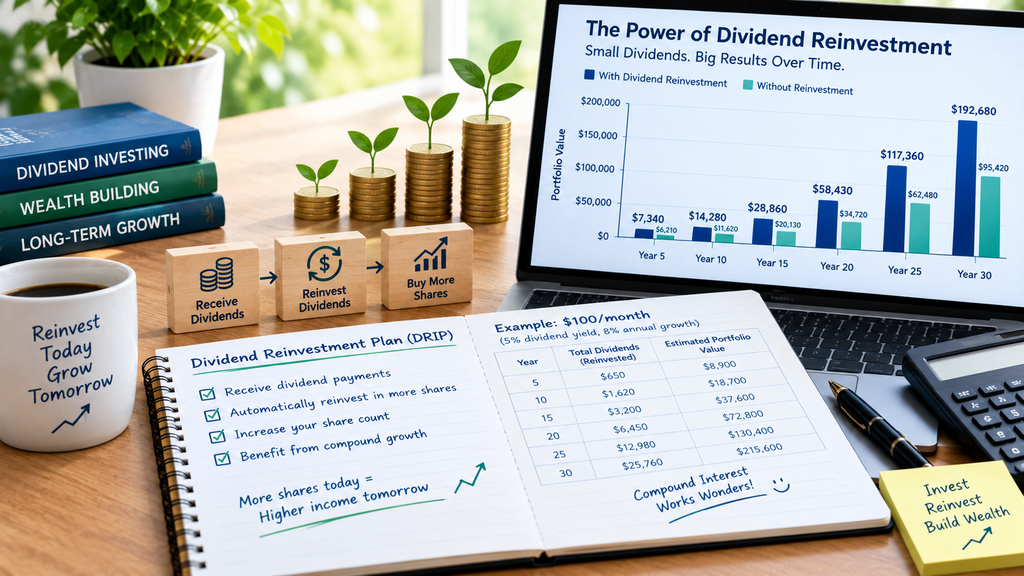
Dividend reinvestment means using your dividend payments to purchase additional shares rather than taking the money as cash.
For example:
You own shares worth $10,000 and receive $400 in dividends.
Instead of withdrawing the $400, you reinvest it into the investment.
The additional shares can potentially generate future dividends, creating a compounding effect.
The process can look like:
Dividends → More shares → More potential dividends → More shares
Dividend reinvestment does not guarantee profits, and stock prices can fall. But over long periods, reinvestment can be an important component of total returns.
Benefits of Dividend Investing
Dividend investing can offer several potential advantages.
Potential Income
Dividend-paying stocks can provide cash distributions to investors.
This can be useful for investors seeking income from their portfolios.
Long-Term Compounding
Reinvesting dividends can increase the number of shares you own.
Over time, those additional shares may generate additional dividends.
Potential Capital Appreciation
Dividend-paying companies can also increase in share price.
Therefore, an investor’s total return may come from both:
Dividend income + Capital appreciation
Neither component is guaranteed.
Focus on Established Companies
Many dividend-paying companies are mature businesses with established revenue and cash flows.
However, dividend payment alone does not mean a company is financially strong.
Risks of Dividend Investing
Dividend investing has risks that investors should understand.
Dividends Can Be Reduced
Companies are not required to maintain their dividend indefinitely.
A business facing falling profits, excessive debt, or cash-flow problems may reduce or eliminate its dividend.
Stock Prices Can Fall
Receiving dividends does not protect you from losses in the underlying investment.
A stock can pay dividends while its market value declines.
High-Yield Stocks Can Be Risky
A very high dividend yield can sometimes be a warning sign.
For example, if a stock’s price falls significantly while its dividend remains unchanged temporarily, its calculated yield can rise.
Investors should investigate why the yield is unusually high.
Sector Concentration
Some industries have historically had more dividend-paying companies than others.
Concentrating too heavily in one industry can increase portfolio risk.
Inflation Risk
Dividend income that does not grow over time may lose purchasing power as prices rise.
Dividend growth can help, but it is not guaranteed.
What Makes a Good Dividend Stock?
There is no single formula for identifying a good dividend stock, but investors commonly examine several factors.
Consistent Dividend History
Look at whether the company has maintained or increased its dividend over a long period.
Earnings
A company’s ability to generate sustainable profits is important.
Free Cash Flow
Dividends ultimately require cash.
Strong and consistent free cash flow can provide greater support for dividend payments.
Payout Ratio
The payout ratio compares dividends with a company’s earnings.
A simplified formula is:
Payout Ratio = Dividends ÷ Net Income × 100
For example, if a company earns $10 million and pays $4 million in dividends:
$4 million ÷ $10 million × 100 = 40%
A lower payout ratio can provide more room for a company to maintain its dividend, although an appropriate ratio varies significantly by industry and business model.
Debt Levels
A company with substantial debt may have less financial flexibility.
Investors should consider debt alongside earnings, cash flow, and other financial metrics.
Dividend Investing Example
Imagine an investor purchases $20,000 worth of dividend-paying stocks with an average dividend yield of 4%.
If the dividends remain unchanged:
$20,000 × 4% = $800
The portfolio could generate approximately $800 in annual dividend income.
If the investor reinvests those dividends, the portfolio may acquire additional shares.
But the actual outcome can differ because stock prices, dividend payments, taxes, and investment choices can change over time.
Dividend Investing vs. Growth Investing
Dividend investing and growth investing have different focuses.
| Feature | Dividend Investing | Growth Investing |
| Main focus | Income + total return | Capital appreciation |
| Dividends | Usually important | Often less important |
| Reinvestment | Common | Often focused on business growth |
| Typical target | Income and long-term wealth | Long-term price growth |
| Risk | Varies by investment | Varies by investment |
These approaches are not mutually exclusive.
Some companies can provide both dividend income and significant growth.
How Beginners Can Start Dividend Investing
A beginner does not need to immediately build a large portfolio of individual dividend stocks.
A basic approach could involve:
Step 1: Understand Your Goal
Decide whether your priority is current income, long-term growth, or a combination.
Step 2: Learn the Fundamentals
Understand concepts such as:
- Dividend yield
- Payout ratio
- Earnings
- Free cash flow
- Debt
- Dividend growth
Step 3: Diversify
Avoid putting your entire portfolio into one company.
Diversification across companies and industries can help reduce the impact of a single investment performing poorly.
Step 4: Consider Dividend-Focused Funds
Some investors prefer diversified funds or exchange-traded funds that focus on dividend-paying companies.
These can provide exposure to multiple holdings through a single investment.
Step 5: Reinvest When Appropriate
If you do not need the dividend income immediately, reinvesting may help increase your ownership over time.
How Much Money Do You Need for Dividend Investing?
There is no universal minimum amount required to begin investing.
The amount you need depends on:
- Your brokerage
- The investment you choose
- Share prices
- Minimum investment requirements
- Your financial goals
What matters more than starting with a large amount is having a sustainable investment strategy.
For example, consistently investing a smaller amount may be more practical for many beginners than investing a large amount they cannot comfortably afford.
Should You Focus Only on Dividend Stocks?
Not necessarily.
A portfolio built exclusively around dividend stocks may miss opportunities in companies that reinvest profits rather than pay dividends.
Your investment strategy should reflect your:
- Time horizon
- Risk tolerance
- Income needs
- Financial goals
- Overall portfolio
Dividend investing can be one component of a diversified investment strategy rather than a requirement for every investor.
Common Dividend Investing Mistakes
Chasing the Highest Yield
A high yield does not automatically mean a better investment.
Always investigate the company’s financial health and the sustainability of the dividend.
Ignoring Total Return
An investment’s performance is not determined by dividends alone.
Consider both income and changes in the investment’s value.
Forgetting Taxes
Dividend income can have tax consequences depending on your country, account type, and investment.
Understand the applicable tax rules before making investment decisions.
Lack of Diversification
Holding only a few dividend stocks can expose your portfolio to company-specific risk.
Assuming Dividends Are Guaranteed
Dividends can be reduced or eliminated.
Treat them as potential investment income, not guaranteed income.
Final Thoughts
Dividend investing can be an attractive strategy for investors who want to combine potential income with long-term wealth building.
However, the best dividend investments are not necessarily the stocks with the highest yields. Investors should consider dividend sustainability, earnings, cash flow, debt, payout ratios, growth prospects, valuation, and overall portfolio diversification.
Reinvesting dividends can also help increase the number of shares you own and potentially strengthen long-term compounding.
Before investing, make sure the strategy fits your financial goals, risk tolerance, and time horizon. A well-researched and diversified approach is generally more important than simply choosing stocks because they offer a large dividend.
One thought on “Dividend Investing: A Beginner’s Guide to Earning Income From Stocks”